Shopify’s Spring Editions 2026 drop on June 17, 2026 was not mainly about another theme polish or a longer feature list. The center of gravity moved: discovery and purchase can leave your storefront and land inside AI agents that search, recommend, and check out on a shopper’s behalf.
If a human used to land on your PDP and scroll, an agent now asks a different question first: Can I trust this product record enough to recommend it? Messy catalog data fails that test. Clean, structured inventory passes it.
That is the strategic read of Spring ’26. The protocol and APIs matter. Your titles, variants, and metafields decide whether those systems can see you.
The paradigm: humans browse; agents query
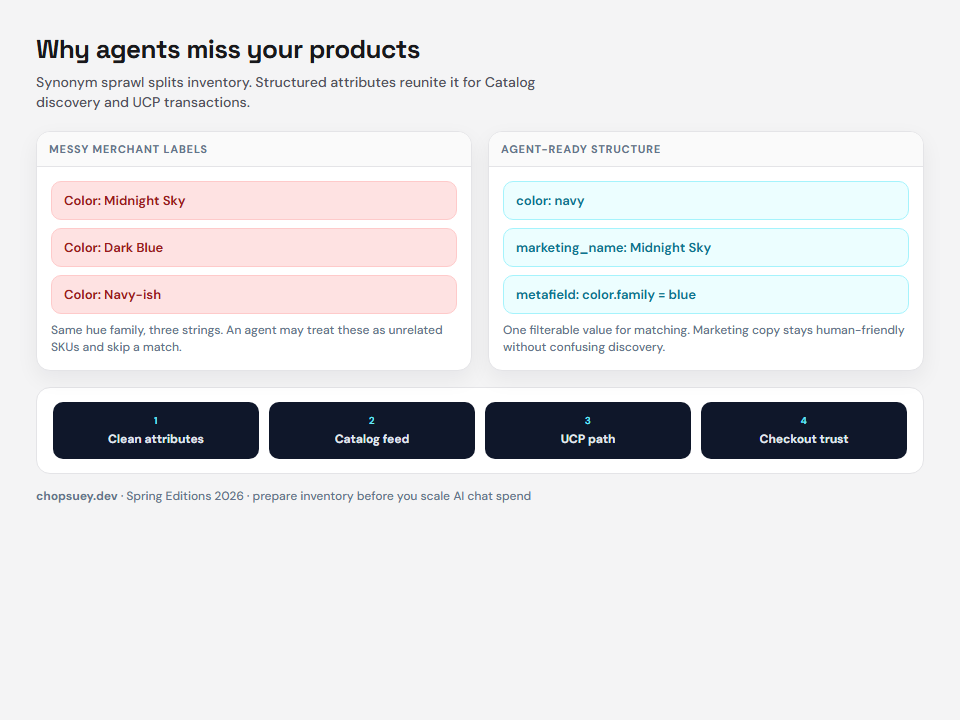
Think of a shopper as someone walking a store aisle. They forgive odd shelf tags. An AI agent is closer to a warehouse scanner. It needs explicit parameters. If one SKU says color Midnight Sky and another says Dark Blue for the same hue family, the agent may treat them as unrelated inventory. You lose a match you would have won with a standardized navy (or a shared color metafield).
| What you optimized for | What agents need |
|---|---|
| Keyword-rich titles for Google | Stable attributes agents can filter on |
| Story-heavy descriptions in widgets | Machine-readable copy in theme HTML |
| Visual merchandising only | Structured options, metafields, accurate stock |
| Checkout on your domain only | Trust and payment flows agents can complete |
Spring ’26 ships infrastructure for that second column. Merchants who treat Editions as a press-release checklist will miss the operational work.
Universal Commerce Protocol (UCP): a shared language for transactions
UCP is an open standard for how AI agents talk to merchants across discovery, cart, and checkout. Shopify co-developed it with Google and positioned it as protocol infrastructure, not a single vendor product. Industry backing from major platforms matters less as marketing and more as a signal: agents will not want twelve proprietary checkout dialects forever.
Analogy: HTTP did not invent websites. It made browsers and servers interoperable. UCP aims to do similar work for agentic shopping. Developers register agents and call public endpoints. Merchants feel the impact when their products become reachable through those agents if the catalog layer can describe them clearly.
You do not need to implement UCP yourself to prepare. You need inventory and storefront markup that survive a machine-readable pipeline.
Catalog API: the discovery layer agents actually trust
The Shopify Catalog API (and the broader Catalog / MCP discovery stack in this Edition) turns merchant products into structured, queryable data. It is the feed agents use instead of brittle HTML scraping.
Shopify has reported that AI searches powered by Catalog convert at roughly 2x the rate of scrapes. Treat that as a vendor-reported direction, not an audited guarantee for your niche. The directional lesson still holds: structured catalog beats scraped guesswork.
What fails in Catalog-era discovery:
- Synonym soup on color, size, and material (
Midnight/Dark Blue/Navywith no shared taxonomy) - Variants that hide critical attributes only in image alt text
- Descriptions locked in app embeds or iframes that crawlers and agents skip
What wins:
- Consistent option names and metafield schemas
- Accurate availability and delivery signals where Catalog exposes them
- Native theme content agents can parse without reverse-engineering widgets
Universal Shop Pay: checkout trust beyond Shopify domains
Universal Shop Pay expands Shop Pay so brands can offer it on non-Shopify storefronts too. For multi-platform operators, that is a conversion story: familiar one-tap checkout and Shop identity can travel with the buyer even when the cart is not hosted on Shopify Liquid.
Strategically, this pairs with agentic commerce. Agents and shoppers both need a payment path they already trust. Expanding Shop Pay’s surface area reduces friction when the purchase starts in an assistant or on an external site, not only when it starts in a classic Shopify theme.
If you run Shopify plus another stack, revisit payment UX consistency across channels. Conversion gaps often hide in mismatched checkout habits, not in catalog alone.
Sidekick leaves the admin silo
Spring ’26 upgrades Sidekick so it can work across installed apps, not only core Admin screens. Shopify has highlighted third-party workflows such as pulling marketing context from tools like Klaviyo and running multi-step ops without tab-hopping.
That is powerful for lean teams. It is also a governance problem:
- Define who can approve Sidekick actions that spend budget or change campaigns
- Review outputs before bulk catalog or ESP changes go live
- Map which apps actually expose Sidekick actions in your stack
Treat Sidekick as a junior operator with permissions, not as autopilot for brand-critical systems.
Campaign Autopilot and free AI chat with native checkout
Campaign Autopilot aims to run and learn across marketing channels with less manual campaign assembly. Use it with a leash: start on a contained segment, watch creative drift, and keep human approval on budget and offer rules.
Free AI-powered customer service chat that can process checkouts inside the conversation collapses support and sales. Upside: fewer handoffs. Risk: wrong product match, stale inventory, or tone that does not match your brand. Pilot on high-FAQ SKUs first. Measure deflection and refund rates, not only chat volume.
Together with UCP and Catalog, these features push Shopify from “AI in the admin” toward “AI in the buyer’s path.” Catalog hygiene still decides whether those agents recommend you.
Scale signals: POS v11 and complex commerce
POS version 11 and expanded native support for multi-entity and international B2B wholesaling reinforce the same theme: one commerce backbone across channels. For most D2C operators, these are supporting context. The near-term competitive edge from Spring ’26 is still agent-readable inventory, not a POS version bump alone.
Three actions to take now
Do these before you chase another AI marketing experiment.
- Audit product titles, variants, and metafields. Standardize attributes agents filter on. Collapse synonym sprawl (
Midnight Sky/Dark Blue→ one controlled color value plus optional marketing copy). Fix incomplete options on bestsellers first. - Review storefront code for trapped content. If key descriptions live only in iframes, heavy app embeds, or client-only widgets, move critical product facts into theme HTML / Liquid that crawlers and agents can read.
- Run Shopify’s AI readiness / Catalog diagnostics. Use the free diagnostic tooling Shopify provides to baseline Catalog and agentic readiness, then fix the highest-impact gaps before promoting AI chat or Autopilot spend.
Agentic commerce rewards stores that treat product data as infrastructure. Spring Editions 2026 made that infrastructure public. The bottleneck is still on your catalog team, not on the keynote stage.
chopsuey.dev
Shopify development, websites, and workflow automation for stores that outgrew templates. Projects → · Let’s talk →