Most people discover self hosting through one pain point. A cloud tool raises prices, a feature disappears, or privacy settings get murky. Then a small home server appears, followed by another service, then another.
That path is familiar, but the better story is this: self hosting is not only a tech hobby. It is a way to build reliable creative systems around hobbies you already care about.
This guide covers hobby tracks where local control makes a real difference. It is not about collecting containers for bragging rights. It is about better outcomes, lower friction, and tools that still work next year.
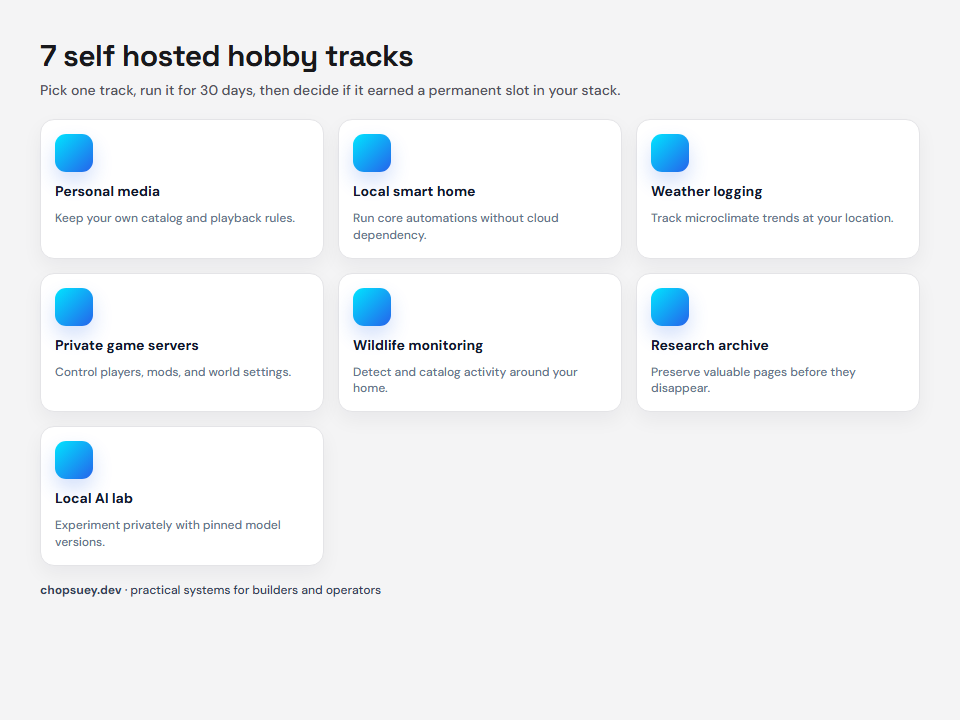
1. Personal media library you can keep
If you watch films, collect concerts, or archive family video, self hosting gives you continuity. Licensing changes do not erase your library. App redesigns do not hide your metadata.
- You control catalog structure, naming, and artwork
- Playback remains available even if a vendor drops support
- Family sharing stays in your rules, not a platform policy
2. Smart home that still works offline
Cloud assistants are convenient until your internet fails or a vendor changes its roadmap. Local automation shifts core control back to your network.
- Device triggers stay responsive during outages
- Sensor data remains private by default
- Automations become transparent and easier to debug
3. Hyperlocal weather and environment logging
Public weather apps are good for city-level forecasts. They are weaker for your exact roofline, garden, or street corner. A local station gives you precise context.
- Historical trends for your own property
- Alerts tied to your thresholds, not generic defaults
- Automation hooks for HVAC, irrigation, or shades
4. Private game worlds for your own group
Public servers are easy to join, but they are not always where you get the best sessions with friends. A private server gives you stable rules and known players.
- You control access and moderation
- You pick version timing and mod strategy
- World progress survives platform changes
5. Wildlife and garden monitoring
Self hosting gets interesting when it leaves the screen. Cameras and microphones can help you observe patterns in your own environment, from visiting birds to nighttime movement.
- You own retention policy for image and audio data
- Detection models can be tuned for your location
- Events can trigger useful reminders and logs
6. Personal web archive and research vault
Useful pages disappear often. Documentation moves, blogs shut down, and forum answers get deleted. A local archive preserves sources you rely on.
- Research stays searchable over time
- Source material remains available for future projects
- You can build your own tagging and reference structure
7. Local AI lab for private experiments
Cloud AI tools are fast to start. Local models give you control over data, model choice, and cost profile for ongoing experiments.
- Prompts and project files stay on your hardware
- You can pin model versions for reproducible workflows
- You build pipelines that match your exact use case
A practical way to start without burnout
Pick one hobby track and run it for thirty days before adding a second service. Document setup steps while they are fresh. Track downtime and maintenance time so you know if the stack is helping or distracting.
Self hosting works best when it supports the hobby, not when it becomes a never ending tool chase.
Bottom line
The best self hosted setups are quiet. They do not demand attention every night. They make your hobbies more reliable, more private, and more fun to sustain.
If you want to build one carefully, start small, choose a clear success metric, and own the boring parts like backups and updates. That is what keeps the project useful after the novelty fades.
chopsuey.dev
Shopify development, websites, and workflow automation for stores that outgrew templates. Projects → · Let’s talk →